
RAN
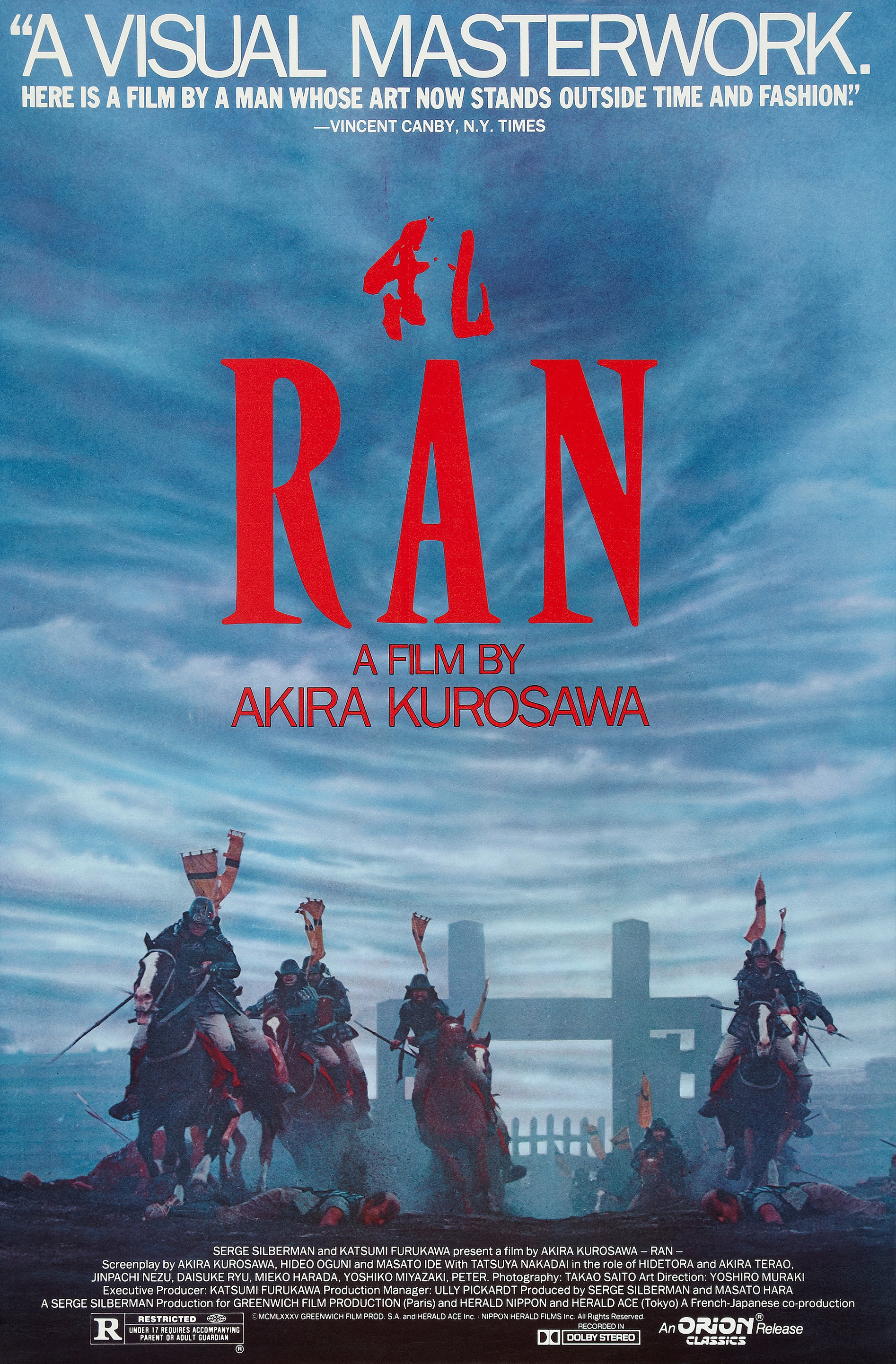
Akira Kurosawa's masterpiece "RAN" has added a lot to the world of cinema, offering a breathtaking medieval Japan story. Kurosawa, who mentioned that his previous film, "Kagemusha," was a costume rehearsal for "RAN" and spent ten years storyboarding each frame of the film, referred to it as his "magnum opus" among his own films. Let's take a closer look at this remarkable work.
The Kurosawa Effect
According to his family, Kurosawa was rarely thinking about
anything other than films and even silently shot scenes in his head even at
home; he was an obsessive individual. After receiving training in painting, he
started his career as an assistant director. He mostly wrote his own films and
was one of the rare directors who visualized his movies in the form of
storyboards. This might be a significant factor in his ability to create such
coherent films. Like Tarkovsky, Kurosawa was also more respected and admired in
the West than in his own country. While he might not have been declared a traitor
to his country like Tarkovsky, his films received numerous awards and even
Hollywood made remakes of his works. For instance, "Rashômon" (1950)
inspired "The Outrage" (1964), "Kakushi-toride no
san-akunin" (1958) inspired "Star Wars" (1977), "Seven Samurai"
(1954) inspired "Magnificent Seven" (1960), and "Yojimbo"
(1961) inspired "A Fistful of Dollars" (1964).
From Shakespeare to Japan
Although he wrote his own films, Kurosawa drew inspiration
from other sources. "RAN" is openly an adaptation of Shakespeare's
"King Lear." In brief, "King Lear" is about a king in the
16th century who wants to divide his kingdom among his three daughters. He
gives each one a castle in different parts of the country and questions their
loyalty. The story begins this way. The film's director, Kurosawa, mentioned
that he started writing the script for "RAN" ten years before it was
released and initially, it shouldn't have been based on "King Lear,"
but during the writing process, it naturally evolved into a "King
Lear" adaptation. Nevertheless, it is a fantastic adaptation. Kurosawa
takes each point of the story, deepens, details, and concludes it, creating a
coherent and captivating piece of work.
The Fall of an Empire! What About Family?
Lord Hidetora is an elderly warlord. When he decides to
divide his kingdom among his three sons, the youngest son expresses doubts, but
Hidetora falls for the flattery of his other two sons and hands over all his
power. Unbeknownst to him, this will lead to betrayal, resulting in the downfall
of both the family and the empire. The first half of the story is quite
predictable, but in the middle of the story, at its peak, the film takes a
different, inner journey. From a clichéd story, we witness the loyalty of a
warlord's family, his inner struggles, regrets, and his ultimate fall from
grace.
The Tale of a Man Who Loses Everything
Lord Hidetora, once a highly respected leader, reaches the
lowest point of his life due to old age or perhaps because of his retirement
plans. We witness the journey of a man who loses everything and the various
approaches he takes towards the events related to himself during his character
arc. This allows us to experience the character development we expect and makes
it easier to connect with the character. Throughout the film, we see Hidetora
being betrayed, humiliated, starved, exiled, and narrowly escaping death, all
while experiencing deep regrets. "RAN" offers everything you seek in
such a story.
Authentic Japanese Performances
One of the most important aspects of character-driven
stories is the actors who make us feel their emotions and development. Kurosawa
worked with successful Japanese actors of his time for this ambitious project,
except for Tatsuya Nakadai. Although many of them might not be well-known to
many, it is evident that the casting was done with great care. Sometimes, I
think they tend to overact in close-up shots, but I believe it's due to their
language, as different interpretations can be derived from different languages.
I mentioned close-up shots because the film has a few of them, but overall, the
director, Kurosawa, gives us enough of the performances we need even from wide
shots. One downside of wide shots is that multiple things are happening in the
frame simultaneously, requiring a keen and detail-oriented eye. If you watch
carefully, you might find small mistakes, but in general, it's not easy to
shoot such scenes for such a production. The style suits the epic battle scenes
in particular.
Epic Battle Scenes Without CGI
I often find modern battle scenes dissatisfying due to CGI.
Although there are exceptions, the sight of hundreds of armored and mounted
extras running, explosions, falls, and deaths in old films made it feel more
authentic. "RAN" possesses such wide shots, offering impressive and
detailed epic battle scenes. Just like in "Braveheart" or "The
Last Samurai," they shot all these scenes with guerrilla techniques under
challenging conditions. The horsemen, infantry, and swordsmen are positioned as
they should be. The battle begins, and the two armies clash in an epic manner.
Especially the second castle siege sequence, which is the peak of the film, is
a visual battle spectacle.
The Magic of Natural Light
Speaking of visual spectacles, the film employs natural
light in almost all wide-shot scenes. Using natural light can present several
challenges, but Kurosawa's mastery is evident as the scenes look very natural
and clear. This choice also added another challenge in terms of shooting hours
and weather conditions. Kurosawa wanted the sky to become increasingly cloudy
as the plot advanced. So, they patiently waited for cloudy days as the shooting
progressed. Finally, when strong winds blew during the climax of the story, the
first half of the plot was completed. This required patience and effort.
Secondary Characters Adding Depth
Another point where evident effort was put into is the
supporting characters and their impact on the story. There are many side stories
and characters connected to the main characters, and they don't cause any
confusion as they are interconnected. All of them are details written to
develop the characters concerning the critical issues related to the family
members or the empire. For example, Lady Kaede is the wife of Hidetora's eldest
son, and Hidetora had taken over her family's castle and ordered the execution
of her entire family in front of her. Then, he presented her as a gift to his
eldest son. Naturally, she became full of hatred. After the kingdom's division,
she seizes the opportunity and triggers the conflict by manipulating her
husband. This is a small example, but there are deeply written characters that
affect the story in this way.
A Classic Japanese Production
In conclusion, "RAN" is a timeless film. Each
viewer can find something different to hold onto and relate to in it. During
the filming, when Kurosawa's 39-year-old wife passed away, he took a day off to
mourn. When he returned, he incorporated some of his grief, regrets,
loneliness, and fears into the film. Perhaps, this story was chosen and written
because of his anxieties about the future. In the tale of a man who loses
everything, Kurosawa becomes a man who lost his 39-year-long life companion and
family. "RAN," which means rebellion or chaos in Japanese, is not
just limited to the events and characters in the film but also reflects the
realities Kurosawa experienced in his own inner world. His monumental work,
produced with a 10-year effort, is almost 40 years old today, and it has not
lost any of its originality or impact.
9/10


Comments
Post a Comment