
OPPENHEIMER
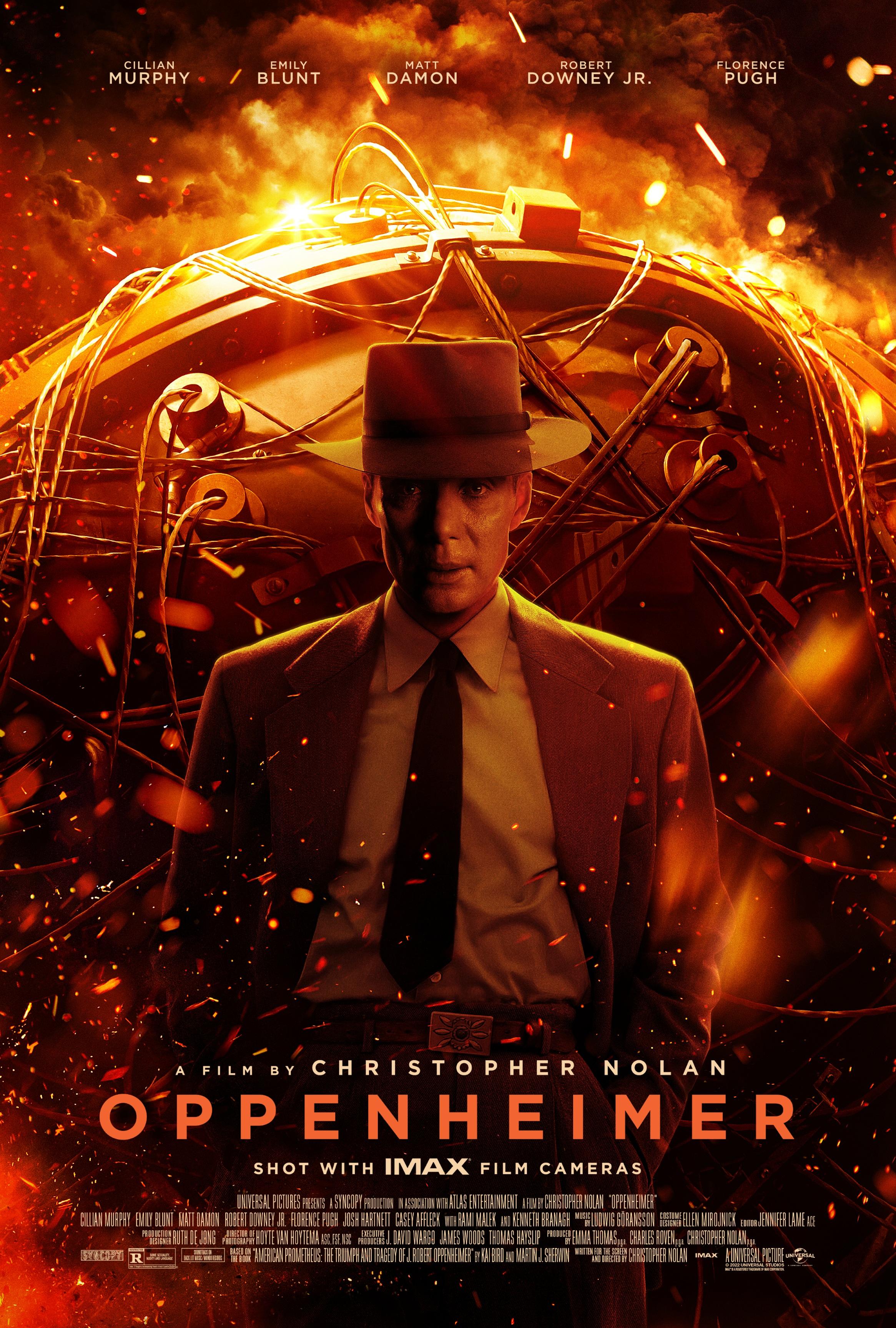
In recent years, with rising budgets and the prevalence of superhero films, we have finally watched Nolan's Oppenheimer, one of the last examples of endangered auteur directors. Technically, I consider the film to be one of the greatest cinematic achievements of all time, especially if you have the chance to watch it in an IMAX theater in your city. But before I delve into that, let me talk about the distinctive aspects of the film.
A Mind-Bending Experience
Although it is categorized as a biographical drama, the film
bears some resemblance to the mockumentary genre in terms of its colorful and
black-and-white scenes, which Nolan uses to skillfully distinguish between
subjective and objective narratives. In the objective scenes, he employs
black-and-white mockumentary-like visuals that we are not accustomed to seeing
on the big screen. The use of time jumps supports the narrative effectively,
and they are utilized seamlessly. If you don't pay close attention, it might be
a bit challenging to follow, but the film doesn't muddle the different
timelines. Most of the related scenes are presented in close succession, and
even flashbacks of characters are carefully placed not to confuse the audience.
The film demands your full attention, not something you can casually watch
while glancing at your phone.
Lord of Atoms, Fellowship of Physics
The film is nearly a direct adaptation of the book
"American Prometheus: The Triumph and Tragedy of J. Robert
Oppenheimer." According to those who have read the book, it adds
significant value to the film as it is based on real events. Many renowned
physicists of that era are featured in the movie, making it even more
compelling if you have a particular interest in physics and are familiar with most
of these scientists. Personally, I recognized about half of these individuals,
and yet, I still thoroughly enjoyed the movie.
A Film Beneficial to Humanity
One of the film's remarkable aspects is seeing all these
significant scientific figures together in one place. Oppenheimer was
surrounded by numerous brilliant minds, most of whom, except Oppie himself,
were Nobel laureates. After watching the film, I couldn't help but delve into
research about Oppie, the Manhattan Project, and other scientists. This is a
testament to the film's success. It presents science and scientists in a
fascinating and awe-inspiring manner, which deserves admiration. I am sure that
many who were moved by the film conducted further research afterward. A
real-life event has rarely been depicted in such a captivating and intriguing
manner. Yes, they might not be Batman, but these geniuses are the true
superheroes, changing our lives forever.
A Thriller (Isn't It?)
It's evident that people who change our lives for the better
don't always do so in a positive direction. Scientists can be compelled to
share their knowledge and discoveries with those who misuse their
powers—sometimes due to pressure from the government or other circles, and
sometimes due to their own egos. Oppie faces a combination of these challenges.
While no one cares, he brings quantum physics to his country and spreads it.
However, when they want to turn this power into a weapon for war, the
government comes knocking on his door. We can't know for sure if his ego or
passion for science blinds him, but what we do know is that his love for
science leads to tragedy for both him and the world. As I said, even though
they are geniuses, they are still human beings. Nolan expertly combines these
internal conflicts with fantastic music and manages to create tension even in
just two lines of dialogue. While two characters converse, I found myself
wondering why I was so tense, only to realize that, like Oppie, I was
questioning everything. The tension permeates throughout the film, and there
were moments that I found more thrilling than films specifically labeled as
thrillers. Adjusting the pace so masterfully is a talent not every director
possesses.
And I Became Deaf: Destroyer of Ears
Ludwig Göransson, who impressed me with "Creed"
and "Black Panther," has delivered an even more exceptional piece of
work than he did in "Tenet." The sounds and music were, in my
opinion, the most impactful aspects of the film. Music can deepen the effect of
scenes on the audience, as seen in many other films, but in this film, it does
more than that—it completely changes the scenes and adds layers to them. When
we delve into Oppie's inner world, especially after the bomb is dropped, the
emotions we feel from the scenes evolve into something entirely different. I
loved this aspect. This could have been your way of compensating for a visually
weak film, but this film is nearly flawless visually as well. The shots are so
clean, detailed, and well-arranged that there isn't a single second where you'd
say, "What was that scene?" Even the moments when the camera loses
focus or goes haywire while depicting Oppie's emotional state are exceptionally
well-done. Hoyte van Hoytema also deserves praise for his contribution in this
regard. Combining all these elements with fantastic sound design? That's how
you create poetry.
Trinity: This Is How You Define an Epic Film
Speaking of poetry, Oppie's love for poetry and his ability
to relate science to art in many ways demonstrate how much of a sensitive and emotional
soul he was. It is not surprising that the Trinity test sequence is the most
epic segment of the film, considering Oppie's penchant for drawing inspiration
from a poem he loves. Nolan, who dislikes the use of computer effects, has
created the most significant explosion in history by simulating the atomic
bomb. And he captured it beautifully. It is an epic sequence that keeps you on
the edge of your seat, with the terrifying sound of destruction echoing
afterward. It was the most epic moment I have ever experienced in a cinema. The
goosebumps I felt, the joyful screams I witnessed, the regretful gazes, and the
audience left stunned, eagerly awaiting what would come next.
Apolitic Genius
After the Trinity sequence, we witness a completely
different Oppie—a character questioning his decisions, becoming aware,
especially experiencing regret. He distances himself from everyone around him.
While Oppie is essentially an apolitical person, he gets involved in politics
for the sake of left-wing women. As the witch hunt for communists continues, he
gets entangled with women who joined the Communist Party. It seems that Oppie
can't escape from troubled waters. With all eyes on him as the person who
created the atomic bomb, when the American society and government see him
express his remorse openly, they turn their backs on him.
The Enmity of Communism and Truman
After much interrogation, Oppie is constantly on edge. This
tension is also palpable for the audience. During the times when the Cold War
is ongoing, the contribution of Oppie and his team has a profound impact on the
arms race. Despite such a significant contribution, security clearances are
revoked after communist investigations. Being betrayed after contributing so
greatly to his country becomes the final blow to his remorse. I'd like to make
a separate mention of Gary Oldman, who played the role of Truman for only five
minutes but managed to be quite disturbing, leaving us with a taste of honey.
Inter-star-ler
Aside from Gary Oldman, we encounter other stars in every
scene. When Nolan is the director, sought-after stars in leading roles may
appear in Oppenheimer only briefly in supporting roles. Josh Hartnett, Casey
Affleck, Rami Malek, Kenneth Branagh, and many others deliver impressive
performances that keep you glued to the screen. Nolan demonstrates his
excellent talent in directing actors. Each actor delivers consistent
performances. There's no overacting or unnecessary exaggeration. Even the lead
actors seamlessly adapt to their roles, making it genuinely challenging to find
any flaws. Emily Blunt, Matt Damon, and Florence Pugh transport you with their
natural performances. In my opinion, the two most compelling stars of the film
are Robert Downey Jr. and, of course, Cillian Murphy. I would love to see these
names in major films more frequently. I'm certain that the Oscars are already
on the horizon, and all I can say is that these actors were flawless in the
film. Seeing them convey emotions to the audience only through their eyes on
the big screen is a precious performance.
IMAX and the Resurrection of Cinema
Speaking of the big screen, unfortunately, only about ten
percent of the world's audience had the privilege of watching this film in its
original form. In only thirty theaters worldwide, the 250-kilogram film was
screened with massive projections in 70mm IMAX, and those who experienced this
must have had an extraordinary experience. Nevertheless, I'm confident that
you'll still be deeply moved watching it in an IMAX theater in our country.
However, on a regular cinema screen, unfortunately, you won't be able to
experience even half of its impact. In fact, watching it at home on a 4K TV
with good headphones or a sound system might be more impressive. This film was tailored
for IMAX, and Nolan, through his close relationship with IMAX, created the only
film with black-and-white analog footage and a three-hour duration. As someone
who advocates for watching Nolan's films in the cinema, he has truly delivered
a film that brings people back to theaters and compels them to buy tickets. We
need more films like this.
This is the F.... Cinema
In short, Oppenheimer is a film that stands out in many ways
and, for me, approaches perfection. It has already earned a place alongside the
classics in my eyes. I haven't watched a film this impressive and unique in a
long time. It tells perhaps the most crucial story of historical events from
the perspective of the most critical figure. It takes you on an emotional
rollercoaster, breaking you down, making you sad, anxious, and deeply
disturbed. Through the empathy established with Oppenheimer, we genuinely feel
his regret when he speaks about it. "And I became death, the destroyer of
worlds..."
9,6/10

Comments
Post a Comment